
Who this is for

Three people, and only one of them ever opens the app. That is not a segmentation exercise — it is what the product already assumes. Three payout methods with different fees, speeds and consequences are three different lives on the receiving end.

These personas are synthetic. Nobody was interviewed, because the product is fictional. What grounds them instead is the product itself — the currencies, the fees, the daily limit, what the Activity screen chooses to show — plus public research on remittance behaviour generally. Where neither of those says anything, the page says so rather than filling the gap.

How to read every claim below

productDerived from something built — a token, a fee, a seeded value, a screen.
sourcedHas a public source about remittance behaviour. Not about this product, and not about any one provider’s customers — the large providers publish no customer demographics at all.
hypothesisMy assumption. Still unverified, and marked so it cannot quietly become a fact.

The three

A man in his forties, indoors by a window, looking into the camera
The sender — the only one who opens the app

Marcos

“Send the usual, to the person I always send to. Know what lands. Know it arrived.”

Age
38–52, peak at 45sourced
Years since migrating
~26 — settled, not recentsourced
Sends from
United States (USD balance)hypothesis
Corridors
BR · PT · US · MX · UKproduct
Typical amount
$120 – $480product
Daily limit
$920product
Frequency
14–17 transfers a yearsourced
Digital adoption
25% at 18–29 vs 7% at 60–69sourced
Picks the payout method
Enters it — does not decide itsourced
productEarns and holds a balance in USD, and sends to named people in five corridors. The app was designed around him end to end.
sourcedAged roughly 38 to 52. Propensity to send money abroad peaks at 40–49 and halves by 70 (Statistics Canada, 2017 data).
sourcedA long-settled migrant, not a recent arrival. In the largest US corridor the sender has been in the country 26 years on average.
productSmall and repeating, not one large event. The seeded history is $250, $480, $120 against a $920 daily limit — personal scale, not business.
sourcedThe order of magnitude survives contact with reality: average principal in the Mexico corridor was $490 in 2024 and $520 in 2025, at 14–17 transfers a year.
sourcedHe operates the transfer but does not freely choose how it lands. A global provider’s published terms let the receiver’s choice of payout method and currency override his instructions, and the screen that picks it is titled “How they collect”.
hypothesisSends from the United States. The USD default points there, and the US is the largest sending country by a wide margin — but that is inference from one configuration line.
marcos-remetente.persona.json119 lines
{  "id": "marcos-remetente",  "name": "Marcos",  "archetype": "Long-settled migrant, sends small and often to the same people",  "source_persona": "lib/personas.ts",  "context": {    "role": "Remittance sender, personal scale",    "region": "United States (inferred from the USD default)",    "devices": [      "mobile"    ],    "a11y_needs": []  },  "goals": [    "send the usual amount to the person I always send to, without re-entering everything",    "know exactly what lands before I confirm",    "know it arrived without having to ask anyone"  ],  "frustrations": [    "a fee that only appears at the end",    "not knowing where the money is between sending and collection"  ],  "behaviors": [    "sends small amounts on a repeating cadence to the same named people",    "checks the arrival figure before confirming, not after",    "picks the payout method the recipient can actually use, not the one he would prefer"  ],  "voice": "plain and unhurried; wants the number, not the pitch; reads the fee line twice",  "runtime_contract": {    "blind": true,    "sees": [      "screens, one at a time",      "its own goal, in its own words",      "its own traits, as self-knowledge — never as a document"    ],    "never_sees": [      "the product spec or the planned user flows",      "design or usability vocabulary",      "which screen or flow it is meant to be on",      "the other personas",      "whether its last action was the one the designer intended"    ]  },  "evidence_ledger": [    {      "trait": "holds a USD balance and sends to five named corridors",      "source": "lib/money.ts, lib/flow.ts#RECIPIENTS",      "confidence": "high",      "tag": "synthetic"    },    {      "trait": "aged roughly 38–52",      "source": "Statistics Canada, Study on International Money Transfers (2017 data) — propensity peaks 40–49",      "confidence": "low",      "tag": "researched"    },    {      "trait": "long-settled migrant, ~26 years in country",      "source": "Inter-American Dialogue, 2026 — Mexican immigrants average 26 years in the US",      "confidence": "medium",      "tag": "researched"    },    {      "trait": "small repeating amounts",      "source": "lib/flow.ts#SEED_TRANSFERS — $250, $480, $120 against DAILY_LIMIT_USD 920",      "confidence": "high",      "tag": "synthetic"    },    {      "trait": "14–17 transfers a year",      "source": "Inter-American Dialogue, 2025 projections",      "confidence": "low",      "tag": "researched"    },    {      "trait": "does not hold the payout-method decision",      "source": "A global money-transfer provider’s online transfer terms (fetched 2026-09-15): “The Sender authorizes Us to honor the Receiver’s choice of method to receive funds or the pay-out currency even if it differs from the Sender’s instructions.”",      "confidence": "high",      "tag": "researched"    },    {      "trait": "sends from the United States",      "source": "inference from the USD send default in lib/money.ts — not a stated fact",      "confidence": "low",      "tag": "synthetic"    }  ],  "grounding": {    "method": "mixed",    "sources": [      "the built product — lib/money.ts, lib/flow.ts, components/prototype",      "design/research-receiver-influence-2026-09-15.md (public secondary research)"    ],    "consent_cleared": true  },  "fidelity": {    "level": "directional",    "basis": "No brief and no interviews: the product is fictional. Traits derive from what was built plus public research about remittance behaviour in general."  },  "guardrails": [    "do not use for pricing-elasticity decisions — the fees in this product are invented",    "do not treat the age range as measured: it is a reading of a propensity curve, and no public source publishes a median sender age",    "do not treat him as the decision-maker for payout method or currency — on a global provider’s published terms that authority sits with the receiver",    "directional only — nobody was interviewed about this product, which does not exist",    "MINTED BY HAND from this demo’s data, not generated by a tool — treat it as a draft.",    "A persona file is normally an internal working document; this one is downloadable only because the product, the brand and the people are all invented."  ],  "needs_clarification": [    "the relationship between sender and recipient — family, partner, employee — which decides the emotional register of any image with both in it",    "whether the card user and the sender are the same person"  ],  "meta": {    "produced_by": "hand, from lib/personas.ts",    "schema_version": "2.0",    "project": "Verion West — design system demo",    "status": "draft",    "created_at": "2026-09-14T00:00:00.000Z"  }}

The brief as Markdown, or the same persona as structured JSON.

A woman in her late sixties outdoors in hard afternoon light, looking into the camera
Receives in cash — never opens the app

Alzira

“Go and collect it, and don’t come home empty-handed.”

Payout method
Cash pickupproduct
Fee she pays for
1.2% + $2.40 — the highestproduct
Arrival
Minutesproduct
Banked
Probably yes — 80% of senders aresourced
Surface in this product
None — a code and a counterproduct
Decides the method
Effectively yes — 74% say sosourced
Decides the brand
No — influences it, 68%sourced
Age
No public anchor existshypothesis
productSits in a corridor where cash pickup is the sender’s default. The product charges the highest fee for it (1.2% + $2.40) and delivers in minutes.
productShe pays for speed. That only makes sense if the need is immediate — which is why her experience is a tracking number and a counter, not a screen.
sourcedCash is not a signal of being unbanked. 45% of senders still use physical agent locations while 80% hold a bank account. We had this wrong first time.
sourcedShe does not pick the company, but she effectively picks the method. 74% of senders in one surveyed market say their transfer method depends on how the receiver can collect, and a global provider’s terms let her choice of method and currency override his instructions.
productThe journey is hers. If the money is not there when she arrives, the cost is a wasted trip — not a notification.
alzira-recebe-em-dinheiro.persona.json108 lines
{  "id": "alzira-recebe-em-dinheiro",  "name": "Alzira",  "archetype": "Cash-pickup recipient; the journey to the counter is hers",  "source_persona": "lib/personas.ts",  "context": {    "role": "Cash-pickup recipient",    "region": "Cash corridors in the seed — São Paulo, Guadalajara",    "devices": [],    "a11y_needs": []  },  "goals": [    "collect the money today, and not make the trip twice"  ],  "frustrations": [    "arriving at the counter and finding the money is not available",    "having no way to check before leaving home"  ],  "behaviors": [    "receives the tracking code through a channel outside this product",    "tells the sender how she can collect, which narrows what he can pick"  ],  "voice": "practical, unsentimental; asks whether it is there, not how it works",  "runtime_contract": {    "blind": true,    "sees": [      "screens, one at a time",      "its own goal, in its own words",      "its own traits, as self-knowledge — never as a document"    ],    "never_sees": [      "the product spec or the planned user flows",      "design or usability vocabulary",      "which screen or flow it is meant to be on",      "the other personas",      "whether its last action was the one the designer intended"    ]  },  "evidence_ledger": [    {      "trait": "cash-pickup corridor with the highest fee and fastest arrival",      "source": "lib/money.ts#PAYOUT.cash — 1.2% + $2.40, minutes",      "confidence": "high",      "tag": "synthetic"    },    {      "trait": "cash is not a proxy for being unbanked",      "source": "Inter-American Dialogue, 2026 — 45% use agent locations, 80% hold a bank account",      "confidence": "medium",      "tag": "researched"    },    {      "trait": "the receiver effectively decides the payout method",      "source": "A global provider’s online transfer terms (fetched 2026-09-15), plus a survey it commissioned, reported by Arab News 2022-12-21 (Saudi cut, n>1,500): 74% say their transfer method depends on how the receiver can collect",      "confidence": "medium",      "tag": "researched"    },    {      "trait": "the receiver influences but does not choose the brand",      "source": "Same survey: 68% say the receiver “influences the company they choose”. The sender remains the one who chooses; a provider executive (NewsBytes.PH, 2022-12-03) scopes receiver influence to frequency and amount",      "confidence": "medium",      "tag": "researched"    },    {      "trait": "no screen in this product",      "source": "components/prototype — the flow has no recipient-facing surface",      "confidence": "high",      "tag": "synthetic"    },    {      "trait": "age unknown",      "source": "no anchored source; the only receiver-age table found summed to 109% and was discarded",      "confidence": "low",      "tag": "synthetic"    }  ],  "grounding": {    "method": "mixed",    "sources": [      "the built product — lib/money.ts, lib/flow.ts, components/prototype",      "design/research-receiver-influence-2026-09-15.md (public secondary research)"    ],    "consent_cleared": true  },  "fidelity": {    "level": "directional",    "basis": "No brief and no interviews: the product is fictional. Traits derive from what was built plus public research about remittance behaviour in general."  },  "guardrails": [    "do not use to represent financial exclusion — cash persists among the banked, and the earlier version of this persona had that backwards",    "do not assign an age: no public source anchors receiver age, and the one table found summed to 109%",    "do not escalate her method authority into brand authority — the sourced verb is “influences”, and the provider’s contract covers method and currency only",    "she never sees a screen in this product; do not use her to evaluate UI",    "MINTED BY HAND from this demo’s data, not generated by a tool — treat it as a draft.",    "A persona file is normally an internal working document; this one is downloadable only because the product, the brand and the people are all invented."  ],  "needs_clarification": [    "her age — no globally representative source exists",    "how far her method authority reaches in practice: the one survey that quantifies it is a single national cut (Saudi Arabia, n>1,500, December 2022) and the provider’s global figure could not be checked — its corporate site was unavailable when this research was done (2026-09-15)"  ],  "meta": {    "produced_by": "hand, from lib/personas.ts",    "schema_version": "2.0",    "project": "Verion West — design system demo",    "status": "draft",    "created_at": "2026-09-14T00:00:00.000Z"  }}

The brief as Markdown, or the same persona as structured JSON.

A woman in her thirties indoors in soft daylight, looking into the camera
Receives into an account — never opens the app

Joana

“Let it land, and let me know when.”

Payout method
Bank deposit · digital walletproduct
Fee
0.6% + $1.20 — the lowestproduct
Arrival
1–2 business daysproduct
Trade she makes
Speed for costproduct
Surface in this product
None — the wait is silentproduct
Split from Alzira
Product design, not measured behaviourhypothesis
productBank deposit and digital wallet corridors. Lowest fee (0.6% + $1.20), 1–2 days. She trades speed for cost, which implies the need is not today.
productBetween send and arrival she has no surface at all in this product. The wait is silent by design, and that is a gap, not a feature.
sourcedHer authority over the method is real but invisible. Holding an account is what widens the menu rather than narrowing it, so the same receiver influence that forces Alzira’s corridor to cash leaves his options open here.
hypothesisSplitting her from Alzira by payout method has no measured basis. The Global Findex does not ask whether a remittance arrived as cash or digitally.
joana-recebe-em-conta.persona.json92 lines
{  "id": "joana-recebe-em-conta",  "name": "Joana",  "archetype": "Bank-deposit recipient; the money simply appears",  "source_persona": "lib/personas.ts",  "context": {    "role": "Bank-deposit recipient",    "region": "Account corridors in the seed — Lisbon, Miami, Manchester",    "devices": [],    "a11y_needs": []  },  "goals": [    "have it land without doing anything",    "know when it landed"  ],  "frustrations": [    "the silence between send and arrival"  ],  "behaviors": [    "takes the slower, cheaper route because the need is not immediate"  ],  "voice": "undemanding; would rather be told than have to check",  "runtime_contract": {    "blind": true,    "sees": [      "screens, one at a time",      "its own goal, in its own words",      "its own traits, as self-knowledge — never as a document"    ],    "never_sees": [      "the product spec or the planned user flows",      "design or usability vocabulary",      "which screen or flow it is meant to be on",      "the other personas",      "whether its last action was the one the designer intended"    ]  },  "evidence_ledger": [    {      "trait": "account corridor, lowest fee, 1–2 days",      "source": "lib/money.ts#PAYOUT.bank — 0.6% + $1.20",      "confidence": "high",      "tag": "synthetic"    },    {      "trait": "no surface between send and arrival",      "source": "components/prototype — no recipient-facing screen exists",      "confidence": "high",      "tag": "synthetic"    },    {      "trait": "an account widens the sender’s menu rather than narrowing it",      "source": "Inter-American Dialogue, 2025-04-16: “A sender’s choice of transfer method varies depending on the options available and the sender’s needs.”",      "confidence": "low",      "tag": "researched"    },    {      "trait": "the cash/account split is unmeasured",      "source": "Global Findex 2025 has no cash-vs-digital receipt question (Remitscope, 2025-10-30)",      "confidence": "medium",      "tag": "synthetic"    }  ],  "grounding": {    "method": "mixed",    "sources": [      "the built product — lib/money.ts, lib/flow.ts, components/prototype",      "design/research-receiver-influence-2026-09-15.md (public secondary research)"    ],    "consent_cleared": true  },  "fidelity": {    "level": "directional",    "basis": "No brief and no interviews: the product is fictional. Traits derive from what was built plus public research about remittance behaviour in general."  },  "guardrails": [    "do not use as evidence of a market split — the cash/account division here is product design, and no globally representative source measures it",    "she never sees a screen in this product; do not use her to evaluate UI",    "MINTED BY HAND from this demo’s data, not generated by a tool — treat it as a draft.",    "A persona file is normally an internal working document; this one is downloadable only because the product, the brand and the people are all invented."  ],  "needs_clarification": [    "whether the cash/account split reflects any real proportion — the flagship financial-inclusion survey does not ask the question"  ],  "meta": {    "produced_by": "hand, from lib/personas.ts",    "schema_version": "2.0",    "project": "Verion West — design system demo",    "status": "draft",    "created_at": "2026-09-14T00:00:00.000Z"  }}

The brief as Markdown, or the same persona as structured JSON.
The correction

The first version of this page put the sender at 25–45. That number had no source — it was instinct wearing the costume of data. One research pass later, the correction went up, not down. The casting the evidence refuses is not the older man; it is the recent arrival in his twenties, which happens to be the image the category reaches for most.

Propensity to send money abroad, by age

18–2928%
40–4945% — peak
70 and over21%

Statistics Canada, Study on International Money Transfers. Data year 2017, n≈23,000.

Digital adoption, by the same ages

18–29 using electronic transfer25%
60–69 using electronic transfer7%
Senders still using a counter45%
Senders holding a bank account80%

The two curves point in opposite directions. That is the tension this product carries.

What this changed in the interface

An app-first product selects the young end of an audience whose money sits at the old end. That reclassifies a finding the visual review had filed as taste: section headings rendering at 12px, smaller than the 16px body they introduce. Against a primary user of 25 that is a typographic quibble. Against a primary user of 45 it is an access debt.

The second correction: who decides

An earlier version of this page carried an open question with a warning attached: that a global money-transfer provider’s own research showed the receiver drives the choice of channel and brand, and that if it held, the hierarchy here was upside down. It was chased down. The answer is more interesting than either the question or the fear.

She does not choose the company. She influences it.

The figure behind the claim is a survey commissioned by that provider, reported by Arab News in December 2022 on a single national cut (Saudi Arabia, n>1,500): “Sixty-eight percent also say their receiver influences the company they choose to send money through.” The verb is influences, and the sender is still the one who chooses. In the same period one of the provider’s executives scoped receiver influence to the frequency and amounts of transfers — not to brand. The global version of the statistic could not be checked: the corporate site was unavailable when this research was done (2026-09-15).

She does decide how it lands — that part is contractual

Stronger than any survey, and easy to miss because it sits in the terms rather than in a press release: the same provider’s online money-transfer conditions state that “the Sender authorizes Us to honor the Receiver’s choice of method to receive funds or the pay-out currency even if it differs from the Sender’s instructions.” Not the brand — the method and the currency. The receiver’s authority is real, and it is narrower and sharper than “she decides”.

The product had already conceded it

Nothing on this page was reordered, because nothing needed to be. Marcos stays primary for a reason that is not a judgement about power: he is the only one who opens the app. But the screen where the payout method gets picked is titled How they collect, every recipient in the seed carries a default method, and the copy under each one reads “usually collects by…”. That is not a sender choosing. That is a sender reporting a fact about somebody else’s life. The interface was already modelling a constrained decision — the research named it.

What we are still buying on trust

One survey, commissioned by the provider, four years old, one country, no independent corroboration found. We agreed to treat the provider as a credible source — and on that agreement the finding still does not reach “the receiver decides”. It reaches the receiver materially constrains the sender’s choice, which is a smaller claim that happens to be the one the evidence supports and the one the product already implements.

Casting

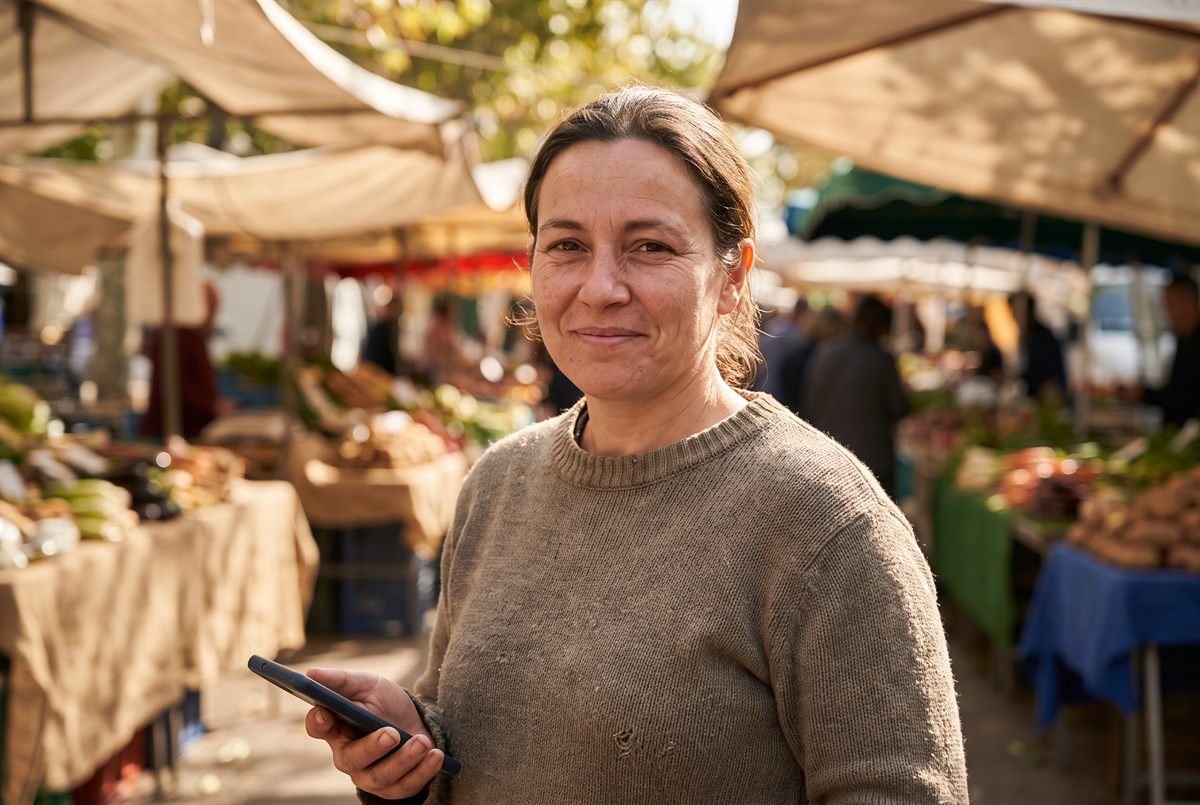
Four generated portraits, all of them in the sender’s register. Each is scored against the curve above, and one was recast on the strength of it.

The direction — looking into the camera, a small closed-lipped smile, calm — is a deliberate choice, and worth naming precisely: it is the register the category advertises, not the one research measures. Peer-reviewed analysis of a decade of this industry’s advertising finds reciprocal care; qualitative work with actual senders finds obligation and strain. Both are true. Only one of them is a photograph.

Portrait in the sender's register — forties, holding a phone with the screen off
StrongestC8-marketForties

Sits on the peak of the propensity curve.

Portrait in the sender's register — mid-forties, holding a phone with the screen off
RecastC7b-windowMid-forties

Was cast in her twenties — the lowest adult band and the stereotype the evidence refuses. Age is the only thing that changed.

Portrait in the sender's register — late thirties, holding a phone with the screen off
StrongC5-kitchenLate thirties

Inside the band, just under the peak.

Portrait in the sender's register — sixties, holding a phone with the screen off
DefensibleC6-doorwaySixties

Above the peak, but 21% still send at 70+, and 45-and-over is the largest band among Filipino workers abroad.

The three avatars, shot after the fact

The four above are all the sender’s register — which is why the receivers had no face until now. These are tighter framings, one per register: Marcos indoors and contained, Alzira outside in hard light, Joana interior and unhurried.

Two things about them are worth saying rather than hiding. Alzira was reshot once because the first frame put her on a European street, which contradicts her corridors in the seed — São Paulo and Guadalajara. And the receivers’ ages are invented: the research pass found no anchored source for how old a person receiving a remittance is, and the one table it did surface summed to 109% and was discarded.

A man in his forties, indoors by a window, looking into the camera
Marcosavatar-marcos.jpg

The sender — the only one who opens the app

A woman in her late sixties outdoors in hard afternoon light, looking into the camera
Alziraavatar-alzira.jpg

Receives in cash — never opens the app

A woman in her thirties indoors in soft daylight, looking into the camera
Joanaavatar-joana.jpg

Receives into an account — never opens the app

What the research could not answer

A research pass is only worth having if it is allowed to come back empty. This one came back empty on more than it filled.

There is no median age of remittance senders

Not globally, not for the US. The flagship financial-inclusion survey has no sender-side module. Pew’s 2024 report on remittances carries no age breakdown at all. The US Census paper cuts by nativity only. What exists is a propensity curve, which is a different object — “45% of 40-somethings send money” is not “45% of senders are 40-something”, and the two get confused constantly.

Who the money actually goes to is unknown

Parent, sibling, child, partner, employee — the split decides the emotional register of every image with two people in it. The only anchored breakdown we found is seventeen years old and covers one occupation in one country. It was not promoted to a fact here.

The primary source could not be checked

The corporate site was unavailable when this research was done (2026-09-15). That is where the global receiver-influence figure is published, so everything this page says about receiver agency rests on secondary reporting of that research, not on the research itself.

Most of this evidence is old

Of the claims that anchored, most breach an eighteen-month freshness bar, and four of the six built on primary survey data come from the same 2017 Canadian study. This subject is thinner in the public record than the ubiquity of its statistics suggests.